
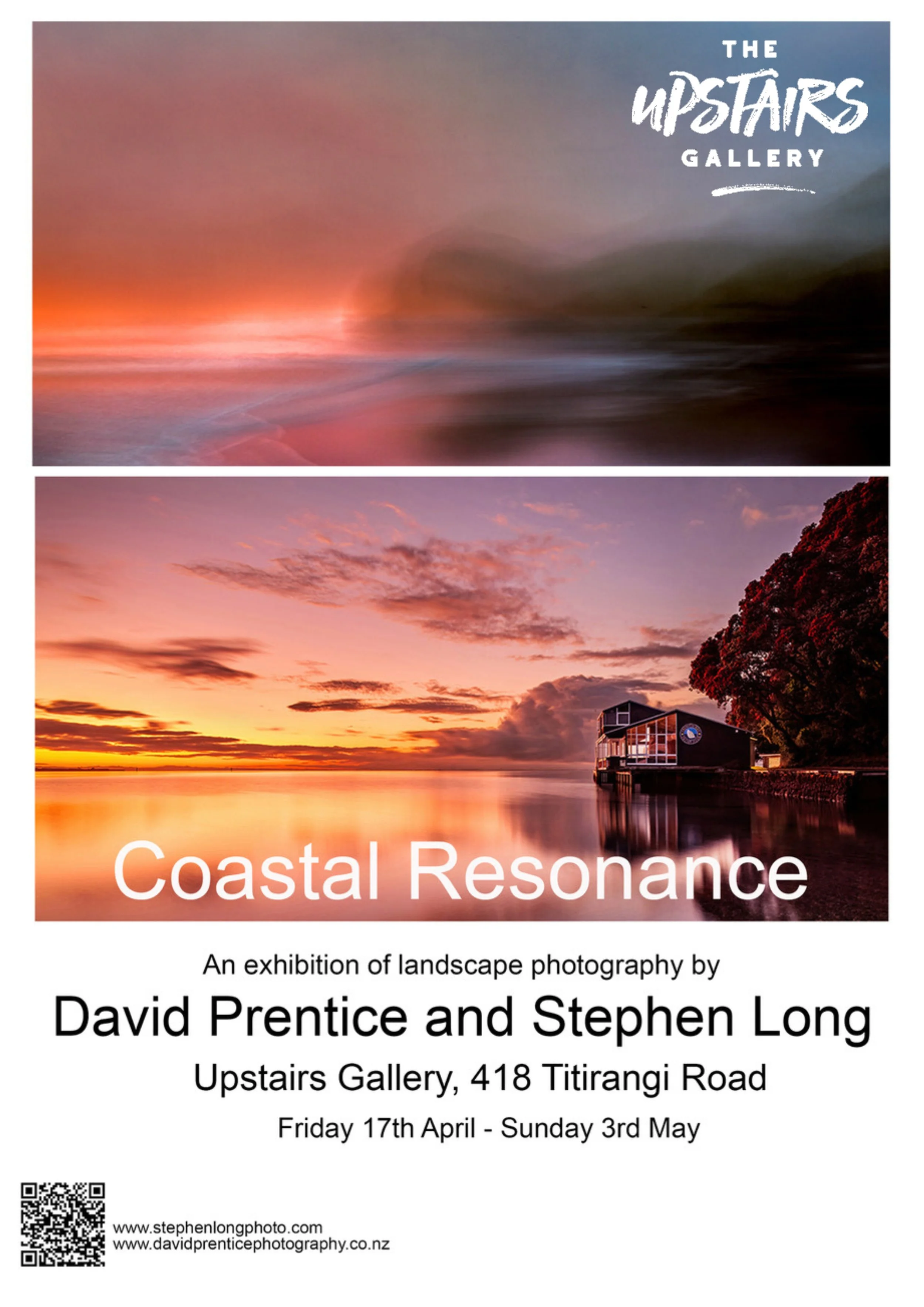
You are invited to the opening of ‘Coastal Resonance’ a photography exhibition by David Prentice and Stephen Long. Opening Friday, 17 April, 6pm - 7:30pm.
About the Artist – David Prentice
My journey with photography began in my late 30’s while living in London. I had recently bought a small point and shoot camera. I found that every street corner in London became a photo opportunity and I became obsessed with photographing anything and everything. I had no prior photography experience prior to this.
A few years after returning to Auckland in 2005 I bought my first DSLR camera and slowly learnt all the different functions. I gradually become more confident and experienced and discovered that I had a really good eye for capturing things. I became skilled at photographing people and discovered landscape photography in 2017. I am now working as a part time professional wedding and landscape photographer as well as working in a fulltime day job.
I am mostly self-taught with camera technique but have learnt so much from other photographers I know who have been generous with sharing their time, experience and skill. I’m living proof that anyone with enough practice, patience and passion bordering on obsession can become a skilled photographer. Examples of my work can be found at www.davidprenticephotography.co.nz
Photographic Concept: Long exposure coastal landscape photography
I am very fortunate to live in Titirangi and close to the West Coast beaches. I specialise in photographing long exposure coastal scenes. I have been using neutral density (ND) filters to extend camera exposure times since 2021. The effect of ND filters is to create artistic, ethereal images of the coastline by using slow shutter speeds to transform moving water and clouds into soft, silky textures while keeping the landscape sharp. This allows a blend of technical precision and artistic vision. For me it is about the relationship between the land, sky and sea and how they fit together to capture a scene and to represent that in a different way.
About the Artist – Stephen Long
My relationship with photography began at the age of eight, recording the places I visited and what surrounded me. What started as literal documentation has evolved into something quite different - a pursuit of feeling over fact and atmosphere over accuracy. Having called Auckland home for more than twenty years, I have found inspiration in the city’s volcanic maunga, wild beaches, sheltered bays and urban landscapes which offer great variety for my creative vision.
I love to photograph weddings, travel and food, but my passion lies with landscape photography. Over the past decade, long exposure photography has become my preferred approach, teaching me that time itself could become a creative tool. This exploration has naturally led me to the technique of intentional camera movement and allowed me to discover innovative ways of interpreting familiar landscapes.
Influenced by photographers including Joel Tjintjelaar, Bruce Percy, Mark Cornick and Shona Perkins, my photography has evolved gradually away from literal representation and towards abstraction and minimalism. I’ve become less interested in documenting specific places than capturing the essence of being in those places - the emotional resonance that invites viewers to connect with their own memories and feelings about the landscape.
Photographic Concept: Intentional Camera Movement
Contrary to traditional photographic approaches which prioritise sharpness, intentional cameral movement (ICM) deliberately introduces controlled blur. This technique abandons literal reality, encouraging viewers to engage with landscapes through feeling rather than fact. Each image is a meditation on presence, time and the intangible qualities which define our relationship with the environment.
ICM photography involves deliberately moving the camera while the shutter is open. This is counter-intuitive for most photographers, as sharpness is usually touted as a key feature of a good landscape photograph. By creating deliberate blur, any pretence of capturing reality is abandoned, and the viewer is invited to connect with the colours, tones and textures of the landscape instead. This disconnect from the literal allows the viewer to attach memories and emotions from their own time spent in the landscape.
On show 17 April - 3 May 2026. Everyone is welcome.